 ThrottleJournal
Bank vs Dealer Financing: Which Is Cheaper?
 By Chong Sem · Updated 8 November 2026
Short answer: a loan you arrange directly with your bank is usually cheaper than dealer financing, but not always. In our ₹8 lakh worked examples, a 9% bank loan has a real annual cost of 9.09%, while a showroom "6.99%" scheme that cancels a ₹40,000 cash discount really costs 9.50%. A dealer offer only wins when its rate is low and you keep the same discount and pay similar fees.
Choosing between bank vs dealer car financing is less about who lends the money and more about what else moves when you accept the offer: processing fees, the cash discount, insurance and how many EMIs you pay upfront. Our car loan guide touches on this briefly. Here we put every common dealer scheme through the same rupee test, so you can see the real cost behind each headline rate.
Is dealer financing different from a bank loan?
Often, not as much as you'd think. A dealer's finance desk usually sources a loan from a bank or NBFC it has a tie-up with. The lender is still a regulated entity, and the loan is still recorded on your credit report. What changes is the package around it:
- Convenience: paperwork happens at the showroom, sometimes with same-day approval.
- Scheme pricing: manufacturers sometimes subsidise a low rate on certain models, usually in exchange for something else, such as a smaller cash discount.
- Add-ons: insurance, extended warranty or accessories may be bundled into the loan.
- Fees: processing and documentation charges may differ from what the same lender charges if you walk into a branch.
Going direct to your bank gives you the bank's own rate card and fees, and keeps the car negotiation separate from the loan negotiation. That separation is the main advantage.
How do you compare a bank loan with a dealer offer fairly?
Compare the Annual Percentage Rate (APR), not the headline rate. The RBI defines APR as "the annual cost of credit to the borrower which includes interest rate and all other charges". Since 1 October 2024, every lender must show it in the Key Facts Statement (KFS) given to you before you sign, along with the full repayment schedule. Insurance and other third-party charges the lender collects must be included in the APR and listed separately.
The APR captures fees and advance EMIs. It does not capture a cash discount you lose by choosing a scheme, because that happens at the dealer, not the lender. So we calculate a second number too: the total you pay for the car, including down payment, every EMI and fees.
Sources: RBI circular on Key Facts Statement for Loans & Advances, 15 April 2024; Bank of Baroda car loan page (processing charge ₹1,500 + GST for loans up to ₹10 lakh).
Bank vs dealer: which is cheaper? Five offers compared
Our assumptions: a car with an on-road price of ₹10 lakh, a ₹2 lakh down payment and an ₹8 lakh loan. The bank rate of 9% is an assumption within Bank of Baroda's current new-car floating range of 7.85% to 11.55%. The bank fee uses Bank of Baroda's published ₹1,500 + 18% GST. The dealer offers are illustrative of common scheme types, not quotes from a particular dealer. APR is calculated by ThrottleJournal as the internal rate of return on the money you actually receive and repay.
| Offer | Headline rate | Tenure | EMI | Upfront cost | Real APR |
|---|---|---|---|---|---|
| A. Bank loan, applied directly | 9% | 60 months | ₹16,607 | ₹1,770 fee | 9.09% |
| B. Same type of loan via dealer desk | 9.5% | 60 months | ₹16,801 | ₹5,900 fee | 9.82% |
| C. Low-rate scheme, no cash discount | 6.99% | 60 months | ₹15,837 | ₹5,900 fee + ₹40,000 discount lost | 9.50% |
| D. 8% with 2 EMIs in advance | 8% | 60 months | ₹16,221 | ₹32,442 (2 EMIs) | 8.60% |
| E. "0% finance", no cash discount | 0% | 24 months | ₹33,333 | ₹18,880 fee + ₹40,000 discount lost | 7.45% |
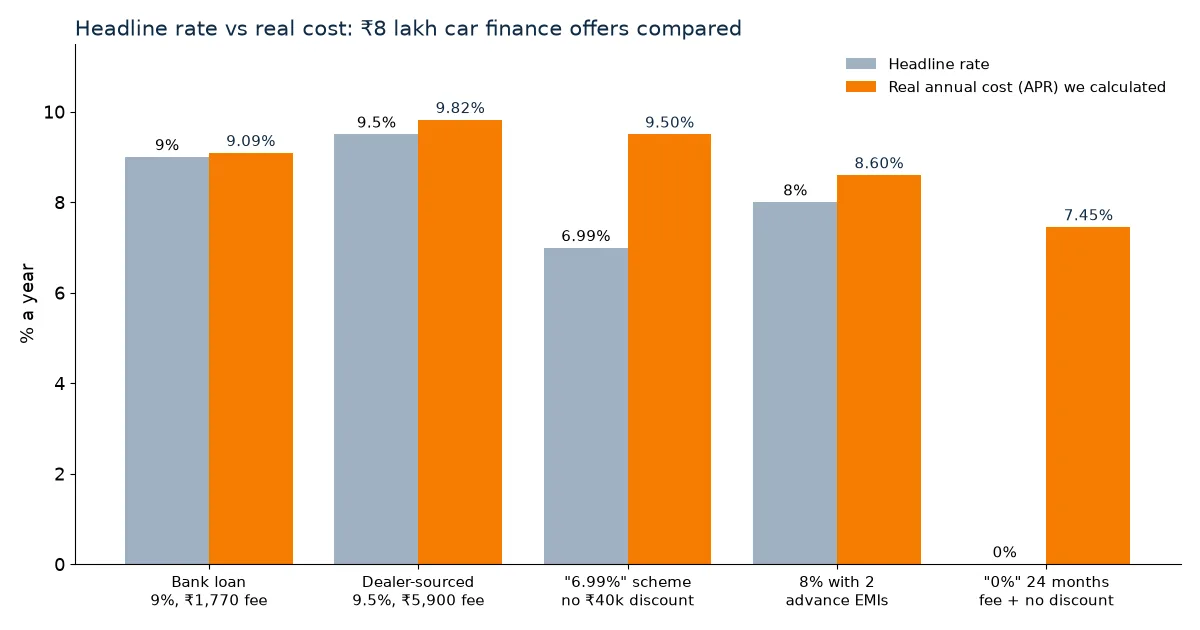
Three things jump out. The plain bank loan's real cost is only 0.09 points above its headline, because its fee is small. The dealer-sourced version of a similar loan costs more on both counts. And the two offers with the lowest headlines, C and E, have the biggest gaps between what's advertised and what you pay.
Low-rate scheme or cash discount: which saves more?
This is the most common showroom choice: take a subsidised rate, or take the cash discount and finance it yourself. Let's work through offer C against a bank loan, with full totals.
Option 1: take the ₹40,000 discount and a 9% bank loan
- Car costs ₹9,60,000. You pay ₹2,00,000 down and borrow ₹7,60,000.
- EMI at 9% for 60 months = ₹15,776
- Total paid = ₹2,00,000 + (₹15,776 × 60) + ₹1,770 fee = ₹11,48,351
Option 2: give up the discount for a 6.99% scheme
- Car costs ₹10,00,000. You pay ₹2,00,000 down and borrow ₹8,00,000.
- EMI at 6.99% for 60 months = ₹15,837
- Total paid = ₹2,00,000 + (₹15,837 × 60) + ₹5,900 fee = ₹11,56,131
The bank route is ₹7,780 cheaper, and its EMI is ₹61 lower too. The scheme's 6.99% headline is real, but the ₹40,000 you gave up is effectively extra money borrowed and repaid, which is why its true cost works out to 9.50%.
Where's the break-even? With these assumptions, the scheme wins only if the discount you give up is less than about ₹34,000. Every dealer offer is different, so redo the sum with your actual numbers: run both loans through our EMI calculator, multiply each EMI by the months, and add the down payment and fees.
How do advance EMIs change the interest rate?
Some dealer-arranged loans collect one or two EMIs on day one, called "advance EMI" schemes. The EMI is calculated on the full loan as normal, but because you hand part of it straight back, you actually have less money for the same stream of repayments.
Offer D: ₹8 lakh at 8% for 60 months gives an EMI of ₹16,221. With 2 EMIs taken in advance, you pay ₹32,442 at the start, so you effectively receive ₹7,67,558, and then pay 58 more EMIs. Solving for the rate that links those cash flows gives 8.60%, not 8%.
Rule of thumb: on a 5-year loan, each advance EMI adds roughly 0.3 percentage points to the real rate. Make sure the KFS APR reflects it, and compare that APR, not the scheme rate, with your bank's.
Is 0% car finance really free?
It can be close, but read what it costs elsewhere. Offer E is a typical structure: 0% for 24 months, with a processing fee of 2% of the loan plus GST and no cash discount.
- EMI = ₹8,00,000 ÷ 24 = ₹33,333, about double a 5-year EMI.
- Fee = ₹8,00,000 × 2% × 1.18 = ₹18,880
- With the fee alone, the real rate is 2.30%.
- Add the ₹40,000 discount you gave up and it becomes 7.45%.
That's still cheaper than our 9% bank loan, so this is the one scheme in our set that can genuinely beat the bank, provided you can afford an EMI of ₹33,333. Before you stretch for it, check whether that EMI leaves room for fuel, insurance and servicing; the total cost of ownership calculator adds those up.
Bundled insurance and add-ons
Dealers often offer to add the first year's insurance, an extended warranty or accessories to the loan. Each rupee added is borrowed at the loan rate for the full tenure. You're free to buy car insurance from any insurer, so get an outside quote for the same cover (same IDV, same add-ons) before agreeing. Under the RBI's KFS rules, insurance premiums collected through the lender must be shown separately and counted in the APR, so they can't be tucked away.
When does dealer financing make sense?
- A genuine subsidised rate with no discount lost. If the dealer confirms in writing that you'll get the same cash discount either way, a lower rate is simply cheaper.
- Your bank's rate for you is high. If your credit score puts you near the top of a bank's range, a manufacturer-subsidised scheme can beat it. See how your score affects pricing in our guide to credit scores and car loan rates.
- Short-tenure 0% offers you can comfortably afford, as in offer E.
- Speed matters more than a small cost difference. That's a legitimate choice, as long as you know the cost.
How to get the best deal at the showroom: 6 steps
- Get a bank pre-approval first. Ask your bank for its rate, fee and KFS. That's the number to beat.
- Negotiate the car price before discussing finance. Ask: "What's the cash price, with all discounts, if I pay with my own loan?"
- Then ask for the dealer's finance offer and whether any discount changes if you take it.
- Ask whether the rate is flat or reducing, and how many EMIs are collected upfront. A flat quote needs converting first; see flat rate vs reducing balance.
- Get the KFS for both offers and compare APRs side by side.
- Add up total cost (down payment + all EMIs + fees) for each option, using the discounted price where it applies. Pick the lower total.
Frequently asked questions
Is it better to finance through a dealer or a bank?
Usually through a bank, because fees are lower and you keep your cash discount. In our example, the direct bank loan was ₹7,780 cheaper than a 6.99% dealer scheme that cancelled a ₹40,000 discount.
Can I refuse the dealer's loan and still get the same car price?
You can always pay with your own loan. Some discounts are tied to finance schemes, so ask for the cash price in writing before you choose.
Does dealer financing affect my credit score differently?
No. It's still a loan from a bank or NBFC and is reported the same way. But each application creates an enquiry, so avoid applying to many lenders through different channels at once.
What should I check in the Key Facts Statement?
The APR, the total amount payable, the number and size of EMIs, any advance EMIs, all fees, insurance charges and the foreclosure terms.
Last updated: 8 November 2026. Rate range and processing charges as published by Bank of Baroda and may have changed. Dealer offers are illustrative scenarios, not quotes from any dealer. All EMIs, totals and APRs are calculated by ThrottleJournal. This article is for information only and isn't financial advice.