 ThrottleJournal
How Your Credit Score Changes Your Car Loan Rate
 By Chong Sem · Updated 8 November 2026
Short answer: your credit score is one of the biggest factors in the car loan rate you're offered. At Bank of Baroda, which prices car loans on your CIBIL score, new-car floating rates currently run from 7.85% to 11.55%. On an ₹8 lakh, 5-year loan, the top of that range costs ₹87,026 more in interest than the bottom, about ₹1,450 a month, for the same car.
This guide explains how your credit score changes your car loan rate, what that gap costs in rupees, and what you can realistically do before you apply. Our car loan guide covers the wider picture of rates, tenure and down payments. Here we focus on the one input you control in the months before you buy.
What credit score do you need for a car loan?
Your CIBIL score is a three-digit summary of your repayment history, built from the credit information report that banks and lenders file with TransUnion CIBIL. According to CIBIL, the score ranges from 300 to 900, and "a score above 700 is generally considered good". The report behind it covers your loans and credit cards, a month-by-month record of payments, and every enquiry made when you applied for credit. It doesn't include your savings or investments.
Each lender sets its own minimum. Bank of Baroda, for example, states that its minimum CIBIL cut-off for a car loan is 701, while adding that it "takes a holistic view" and the score alone isn't the only criterion. Clearing a bank's minimum gets you considered. Where you land above it decides your rate.
Sources: TransUnion CIBIL FAQ: Understand your credit score and report; Bank of Baroda car loan page.
How does your credit score affect your car loan interest rate?
Most banks now use risk-based pricing: the same loan product carries a range of rates, and your credit profile decides where you sit in it. Bank of Baroda is unusually explicit. Its car loan page says the rate "is based on CIBIL Bureau score of the applicant/co-applicant", and its published rate card shows how wide that range is:
| Loan | Rate type | Range | Gap from best to worst |
|---|---|---|---|
| New car | Floating (repo-linked) | 7.85% to 11.55% | 3.70 points |
| New car | Fixed | 8.50% to 11.20% | 2.70 points |
| Pre-owned car | Floating (repo-linked) | 10.90% to 13.65% | 2.75 points |
Source: Bank of Baroda retail loan interest rates. The repo-linked rate (BRLLR) is 8.15%, made up of the RBI repo rate of 5.50% plus a 2.65% spread. A further 0.05% applies if you don't take the bank's group credit life insurance.
Bank of Baroda doesn't publish which score maps to which rate, and other lenders weigh income, employer and existing loans alongside your score. But the direction is consistent across banks: the best published rate is reserved for the strongest profiles, and a weaker score pushes you up the range. The range itself tells you how much is at stake.
How much more does a low credit score cost?
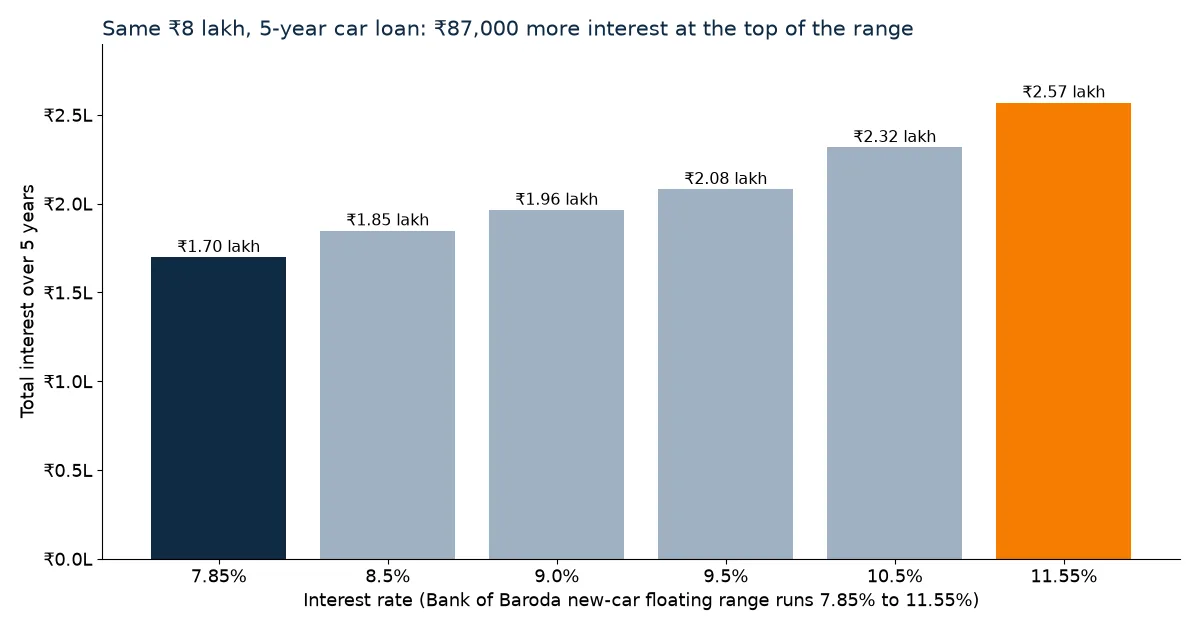
Here's the same ₹8 lakh, 5-year new-car loan priced at points across Bank of Baroda's floating range. We've used the two published ends (7.85% and 11.55%) and four illustrative rates in between.
| Rate | EMI | Total interest | Extra EMI vs 7.85% | Extra interest vs 7.85% |
|---|---|---|---|---|
| 7.85% | ₹16,164 | ₹1,69,825 | – | – |
| 8.5% | ₹16,413 | ₹1,84,794 | ₹249 | ₹14,969 |
| 9.0% | ₹16,607 | ₹1,96,401 | ₹443 | ₹26,576 |
| 9.5% | ₹16,801 | ₹2,08,089 | ₹638 | ₹38,265 |
| 10.5% | ₹17,195 | ₹2,31,707 | ₹1,031 | ₹61,882 |
| 11.55% | ₹17,614 | ₹2,56,850 | ₹1,450 | ₹87,026 |
How the top row works: monthly rate r = 7.85 ÷ 1,200 = 0.006542. EMI = 8,00,000 × r × (1 + r)60 ÷ [(1 + r)60 − 1] = ₹16,164. Total interest = ₹16,164 × 60 − ₹8,00,000 = ₹1,69,825. Our article on how car loan EMI is calculated walks through each step.
Every 0.5 percentage points is worth roughly ₹12,000 of interest on this loan. The gap grows with tenure: over 7 years, the same ₹8 lakh costs ₹2,42,379 in interest at 7.85% and ₹3,70,153 at 11.55%, a difference of ₹1,27,774.
For used cars, rates start higher and the score still matters. On a ₹4 lakh, 4-year pre-owned car loan, the bottom of Bank of Baroda's range (10.90%) means an EMI of ₹10,319 and ₹95,302 of interest; the top (13.65%) means ₹10,860 and ₹1,21,304.
How do your score and income decide how much you can borrow?
Your score sets the price; your income sets the size. Banks cap how much of your income can go to loan repayments. Bank of Baroda's published rule for salaried applicants is that total deductions, including the new car EMI, shouldn't exceed:
- 60% of gross monthly income if you earn under ₹50,000;
- 70% if you earn ₹50,000 to under ₹1,50,000;
- 80% if you earn ₹1,50,000 or more.
Worked example: you earn ₹80,000 gross a month, so up to ₹56,000 (70%) can go on deductions. If you already pay ₹36,000 in other EMIs and deductions, ₹20,000 is left for a car EMI. Over 5 years, that ₹20,000 supports a loan of ₹9,89,870 at 7.85%, but only ₹9,08,359 at 11.55%. A weaker score shrinks the car you can finance by about ₹81,500, before the bank even looks at anything else.
A ceiling isn't a target, though. The bank's limit is about the bank's risk, not your comfort. Our guide to buying a car within your budget suggests a far stricter share of take-home pay.
Can you get a car loan with no credit history?
Yes, at some banks. If you've never had a loan or credit card, your CIBIL score shows as "-1", meaning there isn't enough history to score you. That's different from a bad score. Bank of Baroda states that a CIBIL score of -1 "will also be considered". Expect the bank to rely more heavily on your income documents, employer and down payment, and don't assume you'll get the bottom of the range.
How can you improve your credit score before a car loan?
If you're buying in the next few months, these steps are worth doing now:
- Check your report, not just the score. CIBIL offers a free score option on its site, and your report lists every account and enquiry. Look for loans you don't recognise, closed loans still shown as open, or late payments you didn't make.
- Dispute errors. CIBIL has a consumer dispute process. A closed loan wrongly showing as outstanding can drag down your score and your eligibility, because it inflates your deductions.
- Pay every EMI and card bill on time. Your report records payments month by month, so recent on-time payments steadily improve your record.
- Pay down credit card balances before you apply, so your cards don't look close to their limits.
- Don't apply to lots of lenders at once. Each application is recorded as an enquiry. Get quotes and pre-approvals from two or three lenders within a short window rather than spreading applications over months.
- If you're a guarantor or hold an add-on card, remember those accounts appear on your report too. A default by the main borrower affects you.
What else can lower your car loan rate?
- Add a co-applicant with a strong score. Bank of Baroda prices on the score of the "applicant/co-applicant", and a co-applicant's income also counts towards eligibility.
- Use your existing relationship. Bank of Baroda, for example, offers a 0.25% concession on car loans to existing home loan borrowers with a good repayment record.
- Make a bigger down payment. A smaller loan relative to the car's value is lower risk for the lender, and it cuts interest whatever the rate.
- Choose a shorter tenure if you can afford it. Some lenders price longer loans higher, and a shorter loan reduces total interest at any rate.
- Compare the real cost, not the rate alone. Fees, insurance and advance EMIs can outweigh a small rate difference. See bank vs dealer financing for worked examples.
Is it worth waiting to improve your score?
Put a number on it. If fixing an error or clearing a card balance could move your offer from, say, 10.5% to 9.0%, the table above shows that saves ₹35,306 of interest on an ₹8 lakh, 5-year loan (₹61,882 − ₹26,576), or ₹588 a month. Weigh that against any price rise or offer you might miss by waiting, and against the cost of the transport you'd use in the meantime. Then check the full running cost of the car with our total cost of ownership calculator, so the loan fits the whole budget.
Frequently asked questions
What is the minimum CIBIL score for a car loan in India?
It varies by lender. Bank of Baroda's published cut-off is 701, and it also considers applicants with no credit history (a score of -1). CIBIL says a score above 700 is generally considered good.
Can I get a car loan with a CIBIL score of 650?
It's below some banks' published minimums, such as Bank of Baroda's 701, so approval at those banks is unlikely. Other lenders may approve, usually at a higher rate. Improving your score first or adding a co-applicant with a strong score are often cheaper routes.
Does checking my own credit score lower it?
Enquiries recorded on your report come from lenders accessing it when you apply for credit. Checking your own score is generally treated differently from a lender's enquiry, but many applications in a short time can count against you.
How much does a 1% higher car loan rate cost?
On ₹8 lakh over 5 years, moving from 9.5% to 10.5% adds ₹394 to the EMI and ₹23,618 in total interest. Try your own numbers in the EMI calculator.
Last updated: 8 November 2026. Rate ranges, eligibility rules and concessions are as published by Bank of Baroda (rates effective 8 October 2026) and may have changed. Rates between the published minimum and maximum are illustrative. All EMI and interest figures are calculated by ThrottleJournal. This article is for information only and isn't financial advice.